Understanding Amblyopia
Amblyopia, also known as lazy eye, is a condition where vision did not develop normally during early childhood. Though commonly known as ‘lazy eye’, it should not be confused with squints (a misalignment of the eye).
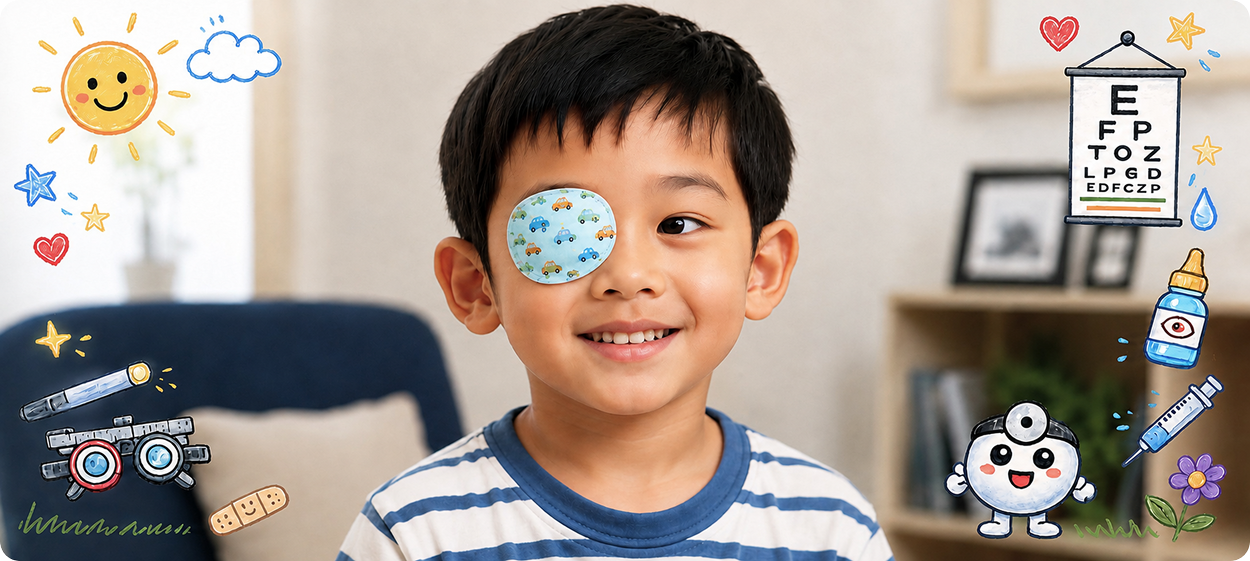



Amblyopia, also known as lazy eye, is a condition where vision did not develop normally during early childhood. Though commonly known as ‘lazy eye’, it should not be confused with squints (a misalignment of the eye).
In early childhood, due to certain causes (see below), if a child's brain has not received clear images from the weak eye/s, vision will not develop normally in that eye/s.
The eye/s is then said to be "amblyopic" or "lazy". After about 7–8 years old, the development of the part of a child's brain that processes vision is almost complete.
This means that the critical time period to treat amblyopia is before this age, otherwise, visual impairment can become permanent.
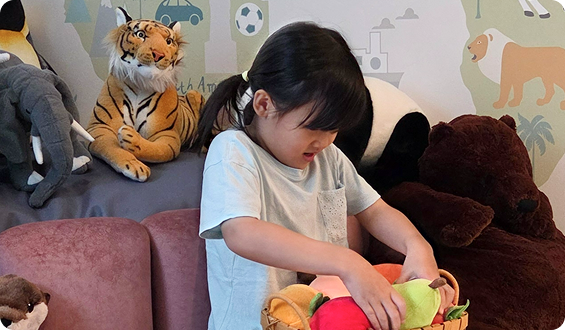

By age 7–8, the part of your brain that helps you see has almost finished developing!
High refractive errors
(short-sightedness / myopia, longsightedness / hyperopia or astigmatism) or a large difference in the degree / refractive power between both eyes
Strabismus / squint
a misalignment of the eyes
Deprivational
Any condition that obstructs vision from a young age (e.g. a droopy eyelid, childhood cataract)
Lots of different things can cause a lazy eye!
Unless there is an obvious cause for amblyopia such as a misalignment of the eye
or a droopy eyelid that is noticed by parents, young children tend not to
complain of poor vision, especially if only 1 eye is affected.
Hence, this may only be detected when vision testing is performed. In Singapore,
vision screening is recommended for all children once they turn 4 or earlier if
there are any concerns. This can be done at the polyclinic, with your Family
Practitioner or Paediatrician. If it is normal, vision should be screened yearly
in schools as part of the Vision Screening Programme in schools.
Four is a great age for an eye screening!
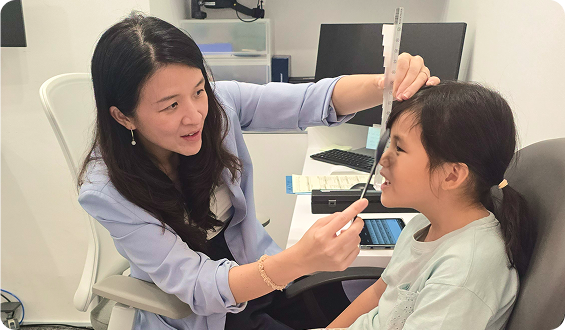
In order to determine if your child has amblyopia and the underlying cause of it, he/she will have to undergo age appropriate vision testing and a refraction (which involves checking the degree of the eye). In younger children the use of eyedrops to relax the focusing muscles of the eye may be required in order to perform the degree check more accurately.
A check for ocular alignment and binocularity is also important to determine the presence of any misalignment of the eyes. A dilated fundal examination may be required to exclude any structural abnormalities that can be a cause of amblyopia.
Eye drops help doctors check your eyes more accurately!
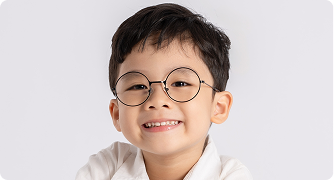
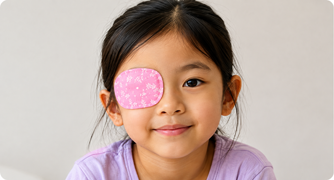
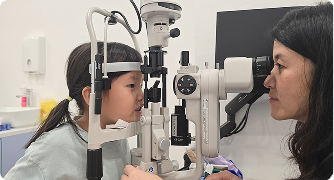
This involves treating the underlying cause, which includes wearing spectacles to correct any refractive error, patching the good eye to allow the use of the amblyopic or "lazy" eye and correcting any obstructive cause such as undergoing surgery for cataracts.
Glasses + patching + surgery - doctors have many tools
Spectacles and Patching
If spectacles are needed for amblyopia treatment, the child should be encouraged to wear them as much as possible during waking hours. A good frame should have a comfortable support at the nose and behind the ears. Sometimes a back strap may be required to prevent the child from pulling the spectacles off.
The aim of patching is to allow the lazy eye to be used more often than the other eye. This can help increase the chance of developing normal vision. If spectacles are required, the child must wear it at all times.

Wear them all day while you're awake!
Treatment may take months to years. The younger the child starts treatment, the easier it is for the vision to improve. Regular reviews are required during the treatment process to monitor visual development and recovery.
When amblyopia treatment is started too late (beyond 8 years old), it may not be possible to reverse the visual impairment.
It is therefore important that you have your child's eyes checked if you suspect a visual problem, or are advised by the school health services to consult an ophthalmologist.
Starting early gives you the best chance of great vision!