​
Start Your Enquiry
We’re just a WhatsApp message away.
Understanding Strabismus (Squints)

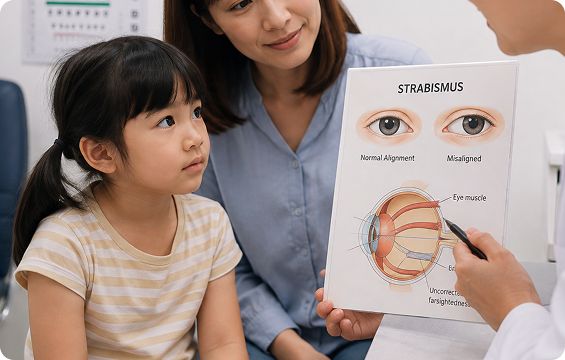
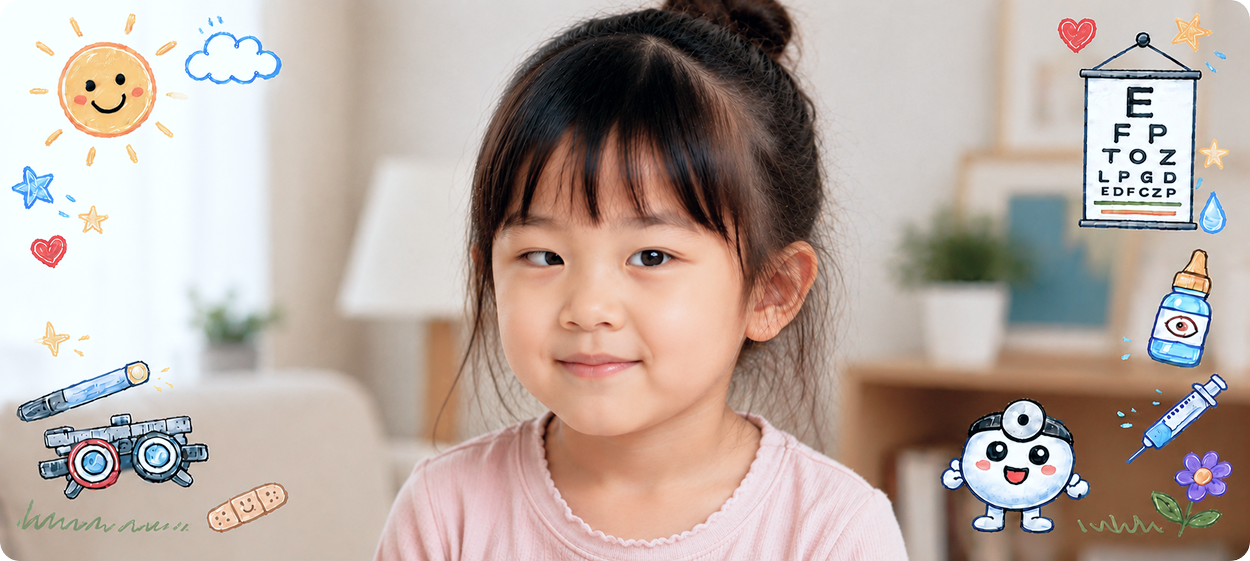
A squint, also known as strabismus, is a condition where both eyes do not look at the same place at the same time.  The squinting eye may be turning outwards (divergent squint), inwards (convergent squint), or even up or downwards with one eye being higher than the other. Strabismus can affect people of all ages, from infants to adults. It can be present all the time or intermittent and only appear when one is tired.
Why does it Happen?

In children, it is commonly caused by an imbalance in the part of the brain that controls the eyes. It can also be caused by a high uncorrected farsightedness that can cause a child's eyes to cross inward as they strain to focus.  Anything that obscures the vision in one eye from early childhood such as a childhood cataract or a droopy eyelid can also result in a squint if the vision in that eye is poor.

Occasionally, and more so in adults,  it may be caused by problems with the eye muscles, the nerves from the brain that transmit information to those muscles or an abnormality in the surrounding tissue within the eye socket.

Finding the cause helps us choose the right care for your child's eyes!

The Risk of "Lazy Eye" (Amblyopia)

When eyes are misaligned, the brain receives two different pictures at once.  In children, to avoid double vision, the brain may learn to adapt and ignore the image coming from the misaligned eye.

If left untreated during childhood, this can cause the ignored eye to never develop normal vision, leading to a permanent reduction in vision known as amblyopia or "lazy eye."

Treating a squint early can help your child’s vision develop properly!

How is Strabismus Treated?

In children, maximizing vision is important and existing amblyopia must be treated first. Thereafter the goals of treatment are to improve eye alignment and restore binocular function (the ability of the eyes to work together)

  • Prescription Glasses

    If there is high hyperopia or refractive error, wearing glasses may be able to improve or straighten the eyes.

  • Patching

    If there is a preference to use one eye over the other and/or if amblyopia is present, placing a patch over the stronger eye forces the brain to use and strengthen the weaker eye.

  • Surgery

    If the squint persists or its control worsens, surgery can be performed to adjust the length or position of the eye muscles to help the eyes align correctly.

  • Exercises

    Convergence and fusional exercises may help to train the eyes to work together and improve control of the squint.

  • Prisms

    these help  to align the two separate images into one and can be useful in adults or older children who experience double vision

The right treatment can help your child’s eyes work better together!

Early Detection is Key

It is a common myth that children will simply outgrow crossed eyes. This is not always the case and if there is a concern early detection is vital for the most successful treatment.

Noticed eye misalignment? Get your child's vision checked early!

MEET OUR
Meet Our Paediatric Ophthalmologist
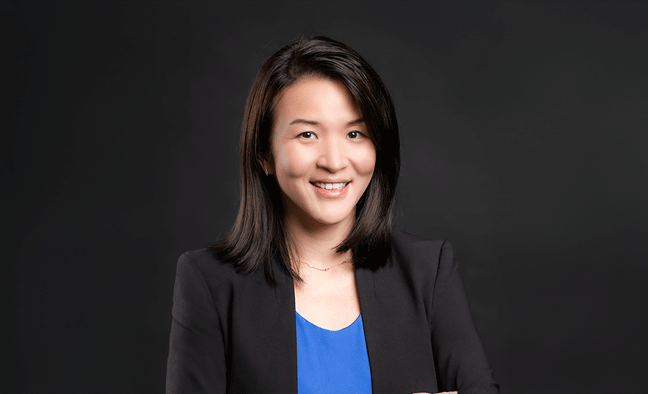
Dr Tay Su Ann - Ophthalmologist
Dr Tay Su Ann
Ophthalmologist
Partner and Senior Consultant
Send Us An
Thank you for your kind interest in Eye & Retina Surgeons, please fill up the form and we will get back to you as soon as possible.
Camden
Novena
*
*
*
Information
Eye & Retina Surgeons
#13-03
Camden Medical
1 Orchard Boulevard,
Singapore 248649
Fax : (65) 6738 2111
Eye & Retina Surgeons
#10-63
Mount Elizabeth Novena Specialist Centre
38 Irrawaddy Road,
Singapore 329563
Fax : (65) 6734 8394
After Clinic Hours
Operating Hours
Mon - Fri
Sat
9.00 am - 5.00 pm
9.00 am - 12.00 pm
Closed on Sunday and Public Holidays
Our Sub-Speciality Services
Eye & Aesthetic Surgeons
Eye & Cornea Surgeons
Eye & Glaucoma Surgeons